A centralized approach to managing infrastructure consistently across your entire client base. Grey-label delivery that operates inside your tools, under your brand.
Infrastructure Management Support for MSPs.
MONITORING ISN'T ENOUGH, YOUR CLIENTS NEED RESOLUTION.
Every MSP knows how to manage infrastructure. The challenge is doing it consistently across dozens of client environments, each with its own configurations, vendors, risks, and service expectations. As you scale, vendor complexity increases, escalations stack up, and projects compete with daily operations. What once felt manageable becomes reactive, and that’s where margins erode. Infrastructure Management Support is built to solve this. It centralizes ownership and standardizes operations across your portfolio, one structure, one set of standards, one accountable delivery model.
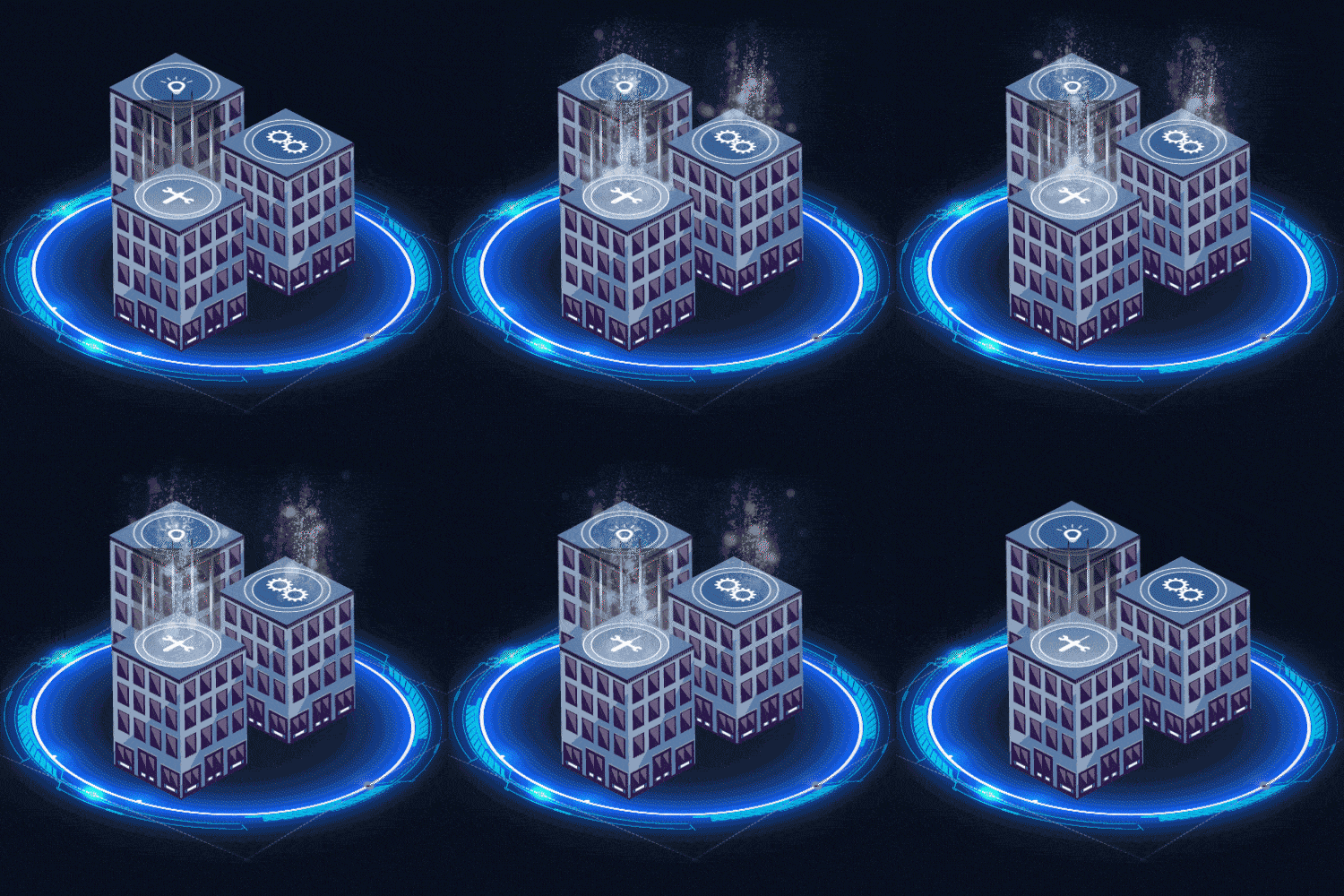
IMS is not another tool. It's not a dashboard. It's a centralized operating structure for how infrastructure gets managed as you scale. Everything runs inside your PSA and RMM, under your brand, as a grey-label extension of your MSP.
THE IMS DIFFERENCE
One Structure. One Standard. Across Every Client
Most MSPs don’t have an infrastructure problem. They have a consistency problem. IMS centralizes ownership, standardizes delivery, and gives you one accountable model across your entire portfolio.
Fragmented Approach
Client A handled one way, Client B handled another
Vendor conversations scattered across people and inboxes
Projects disconnected from daily operations
Escalations multiply with every new account
Performance is invisible until something breaks
VS
Centralized Approach (IMS)
✓ Consistent standards across every client
✓ Consolidated vendor coordination
✓ Integrated project oversight
✓ Escalation paths are controlled and predictable
✓ Visibility across your entire client base
0
+
active MSP customers
0
+
MSP-ready engineers
across India and the Philippines
SOC 0
Type II certified ITBD-owned facilities.
ENGAGEMENT OPTIONS
What Every IMS Engagement Includes
Every IMS engagement with IT By Design includes three things from day one, regardless of which tier or service layer you choose:
Continuous Monitoring
We don’t just watch. We watch everything, all the time, across your client environments.
Remediation Ownership
When issues are detected, they are worked toward resolution inside your environment. We don’t monitor and forward. We monitor and fix.
End-to-End Vendor Management
Vendor coordination is managed from case creation through closure. Your engineers don’t sit on hold.
We do not offer monitoring-only services. If we detect it, we own it through resolution. Proactive maintenance programs are available and scale by engagement tier, so you can choose how deep you want the coverage to go.
OPERATING MODEL
The IMS Operating Framework
IMS organizes infrastructure operations across five coordinated stages. Each stage connects to the next, so nothing falls through the cracks as work moves from detection to resolution to ongoing governance.
Step
1
Detection
Continuous monitoring across servers, networks, and cloud systems. Alerts are validated and prioritized inside your tools, not a flood of noise.
Step
2
Remediation
Issues are resolved directly within your environment, restoring service, correcting configurations, and stabilizing performance. We fix, not forward.
Step
3
Vendor Coordination
When third parties are involved, we manage cases end to end, escalation, tracking, and documentation. Your team doesn't chase vendors.
Step
4
Maintenance by Tier
Engagement depth scales with your service level, from reactive support to structured, proactive maintenance.
Step
5
Governance
Portfolio-level visibility into SLAs, escalations, vendor timelines, patching, and infrastructure health, without chasing reports.
This model ensures infrastructure is managed consistently across your client base. It's the same framework whether you're running NOC, SOC, Helpdesk, RMM administration, or project work through IMS.
SERVICE LAYERS
What's Inside the IMS Stack
IMS combines multiple operational functions into one coordinated framework. Every function operates inside your PSA and RMM systems, under your brand, and aligns to one consistent operating structure.
IMS-STACK ▸ NOCOPERATING
PLUS, ACROSS ALL LAYERS
End-to-end vendor coordination
Infrastructure project delivery
Portfolio-level reporting
VENDOR MANAGEMENT
How does IT By Design handle vendor management for MSPs?
Vendor coordination quietly consumes hours of internal engineering time as MSPs scale. Every new client means more firewall vendors, hardware manufacturers, cloud providers, and ISPs to manage. It adds up fast. IMS centralizes vendor case management for all supported infrastructure and security systems so your engineers don’t spend their day on hold.
Vendor Case Lifecycle
Auto · Stage 1 of 5
Vendor management is included in every IMS engagement. It's not an add-on. It's not a separate line item. When a vendor needs to be involved, we handle it from start to finish.
The Tools We Train On and Operate In
ENTERPRISE TRUST
Trusted by Growth-Focused MSPs
20–70% Labor Cost Savings
+3–8 Points EBITDA Margin Expansion
96%+ CSAT Across Delivery
SOC 2
Type II Certified
900+
Engineers
Trusted by 400+
Growth-Stage MSPs
Keith and Vishal, part of ITBD's team, have been great to work with throughout Q4, consistently polite, professional, and responsive, taking the time to understand our needs. ITBD met our requirements efficiently and delivered. We appreciate the level of communication and follow-through from the entire team, and we look forward to continuing the relationship.
The prompt response, knowledge, and dedication of the ITBD team, making sure every problem is solved in a timely manner, makes ITBD an amazing partnership for our company.
Common Questions About Infrastructure Management Support
What is Infrastructure Management Support?
IMS is a centralized operating structure for managing infrastructure across your MSP’s client base. It includes continuous monitoring, remediation, vendor management, and governance, all running inside your PSA and RMM under your brand as a grey-label extension of your MSP.
Is remediation included in every engagement?
Yes. We do not offer monitoring-only services. When an issue is detected, it is worked toward resolution inside your environment.
Is proactive maintenance included in all tiers?
Maintenance depth varies by engagement level. Reactive remediation is included in every engagement. Advanced preventive programs are available in higher tiers.
Do you manage vendors on our behalf?
Yes. Vendor coordination for all supported infrastructure and security systems is included in every IMS engagement, from case creation through closure.
Do you work inside our PSA and RMM tools?
Yes. All IMS engineers operate directly inside your existing systems. No separate dashboards, no parallel ticket queues, no duplicate reporting.
Is IMS grey-labeled?
Yes. All IMS services operate as a grey-label extension of your MSP. Your clients see your brand, not ours.
What services are included under IMS?
IMS includes Network Operations (NOC), Security Operations (SOC), Helpdesk Support, RMM Administration, Professional Services, vendor coordination, and portfolio-level reporting. Each service has its own dedicated page with full detail.
How does IMS help with profitability?
By centralizing infrastructure operations, IMS improves engineering utilization, reduces escalation loops, lowers cost per endpoint, stabilizes SLA performance, and removes vendor management overhead from your internal team.
What security standards do you follow?
All IMS services operate within SOC 2 Type II certified, ITBD-owned facilities with 100% in-office delivery, biometric access controls, endpoint-restricted systems, and centralized audit logging. No work-from-home access to client infrastructure.
What frameworks does IMS follow?
IMS operations are aligned to ITIL service delivery principles, including structured approaches to incident management, change management, and service continuity. This means how we classify, prioritize, escalate, and resolve work follows a repeatable, industry-recognized model — not ad hoc processes that break as you scale.
How long does onboarding take?
Onboarding timelines vary by service and complexity. NOC onboarding typically takes 30 to 60 days. Other services may be faster depending on scope and integration requirements.